The middle reaches of the Yangtze River Basin are home to numerous run-of-river hydropower stations, which have made significant contributions to regional economic development. However, the operation of these hydropower stations is highly sensitive to hydrological and climatic variations, posing a major challenge to the stability of the power market in Central China. Current research still has limitations in understanding the driving factors and precursor signals of the large-scale circulation. Utilizing multi-source observations and reanalysis data to analyze the climate system and its mechanisms can contribute to theoretical support for run-of-river hydropower forecasting and regulation.
Recently, Associate Professor Huixin Li from the School of Atmospheric Sciences, Nanjing University of Information Science and Technology, along with her student Ke Huang and others, utilized the CN05.1 gridded observation dataset and ERA5 reanalysis data to investigate the primary systems and mechanisms influencing run-of-river hydropower generation in the middle reaches of the Yangtze River Basin, which was recently published in Atmospheric and Oceanic Science Letters.
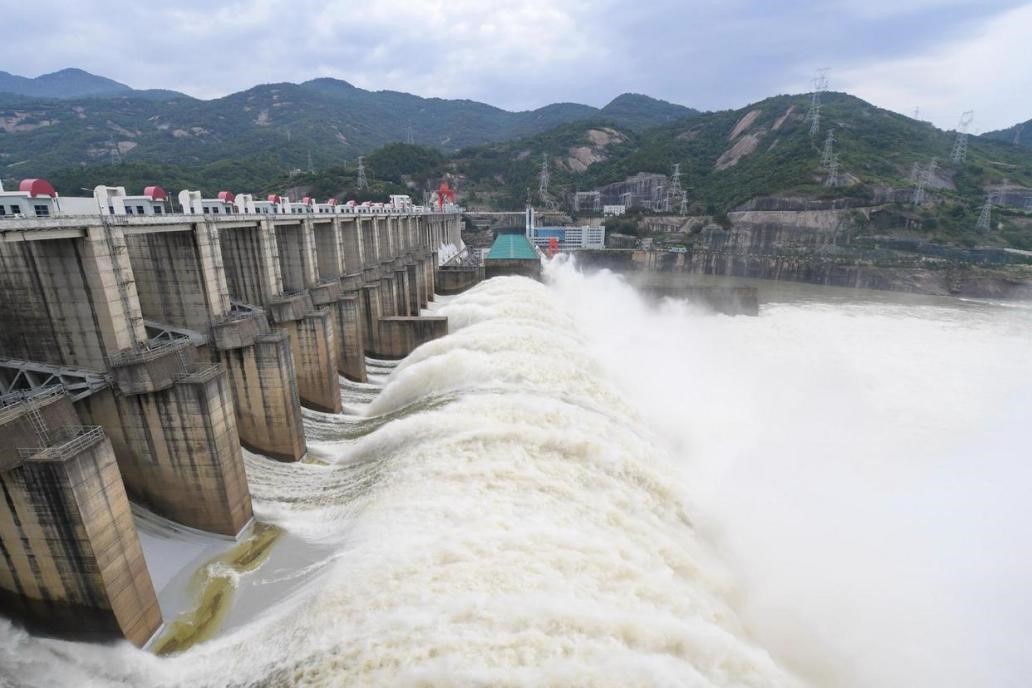
Hydroelectric power station in operation. Credit: Lin Shanchuan.
Their research indicates that regional run-of-river hydropower generation is significantly influenced by local hydrothermal conditions, primarily regulated by the East Asian subtropical westerly jet and convective activities in Pakistan. When the subtropical westerly jet axis shifts southward (northward) and convective activities in Pakistan weaken (intensify), regional hydropower generation increases (decreases).
Anomalous changes in sea surface temperature from the northwestern Indian Ocean and surface temperature from Central Asia in spring will have a significant impact on the westerly jet axis and convective activities in Pakistan in summer, thereby indirectly regulating hydropower generation in the middle reaches of the Yangtze River Basin. This synergistic regulation mechanism reflects the close connection between hydropower production and the East Asian atmospheric circulation system.
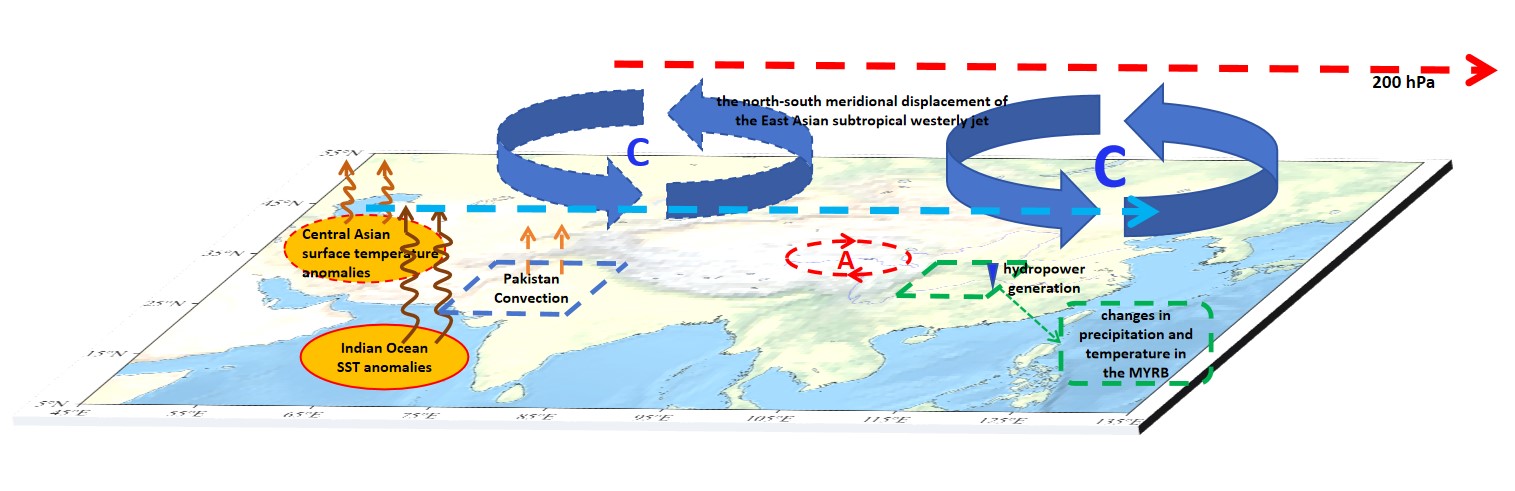
Schematic diagram of the impact mechanism of various climate systems on run-of-river hydropower generation in the middle reaches of the Yangtze River Basin. Credit: Li Huixin.
“Regarding the prediction and regulation of run-of-river hydropower generation, it is necessary to comprehensively consider the dynamic changes of various climate systems and also pay attention to the impact of cross-regional teleconnection,” says the corresponding author, Huixin Li. “This achievement will help toward a better understanding of the meteorological factors driving hydropower production under global warming and provide a theoretical basis for its prediction.”
Citation: Huixin Li, Ke Huang, Bo Sun, Leiyi Hou, Botao Zhou, 2025. Climatic drivers of summer run-of-river hydropower generation in the middle reaches of the Yangtze River Basin: Synergistic effects of subtropical westerly jet dynamics and transregional teleconnections, Atmospheric and Oceanic Science Letters, 100673, https://doi.org/10.1016/j.aosl.2025.100673.
|







 Editor's choices & News