The intermittent nature of solar energy poses challenges to grid stability, making accurate ultra-short-term solar irradiance forecasting crucial for balancing supply and demand. However, traditional numerical weather prediction models often struggle with cloud initialization, leading to forecast inaccuracies.
Recently, Min Chen and Liangchen Guo, researchers from the Institute of Urban Meteorology, China Meteorological Administration, have combined data from the Fengyun-4B satellite with the regional numerical forecast model RMAPS-ST to develop a 0–6 hour ultra-short-term global horizontal irradiance forecasting system for China. Their findings have recently been published in Atmospheric and Oceanic Science Letters, in a paper titled “Ultra-short-term global horizontal irradiance forecasting in China based on satellite and numerical weather prediction models”
The team designed two cloud initialization methods: a passive mode that only accounts for hydrometeor advection and diffusion, and an active mode that nudges hydrometeors during the first forecast hour. Results show that both modes reduce forecast errors by over 7% within the first 15 minutes, with the passive mode performing best within 4 hours. The greatest improvement was seen in summer (~9.41% error reduction), with some regions like Sichuan exceeding 20% improvement.
The corresponding author of the study, Min Chen, explained that, “By correcting initial cloud fields with real-time satellite data, we essentially gave the forecast system a ‘live cloud map’. This is not only a technical breakthrough but also provides a practical tool for grid scheduling and China’s dual-carbon strategy.”
While the system excels in warm seasons and short-term forecasts, errors gradually increase with longer lead times. Future work will integrate dynamic aerosol data and artificial intelligence to better simulate cloud–radiation interactions. This study lays a solid foundation for independent and high-precision solar forecasting in China.
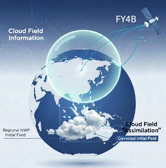
Schematic diagram of the combination of satellite and regional numerical forecasting prediction. Credit: Liangchen GUO.
Citation: Liangchen Guo, Yang Yang, Ruijin Liu, Min Chen, 2025. Ultra-short-term global horizontal irradiance forecasting in China based on satellite and numerical weather prediction models, Atmospheric and Oceanic Science Letters, 100755, https://doi.org/10.1016/j.aosl.2025.100755.
|







 Editor's choices & News