Extreme summer precipitation events in China have grown increasingly frequent and intense, posing severe threats to human life, property, and socioeconomic development. Accurate forecasting of extreme precipitation is crucial for improving disaster prevention and mitigation.
Ensemble forecasting quantifies prediction uncertainty by generating multiple simulations through strategic perturbations, thereby estimating the probability distribution of future atmospheric states.
However, traditional initial perturbation methods using linear singular vectors (SVs) are insufficient to capture the nonlinear evolution of mesoscale convective systems, limiting the accuracy of extreme precipitation forecasts.
To address this issue, the research group led by Prof. Guo Deng at the Earth System Modeling and Prediction Centre of the China Meteorological Administration, China, collaborated with the group of Prof. Yushu Zhou and the group of Prof. Bin Wang at the Institute of Atmospheric Physics, Chinese Academy of Sciences, China. They introduced an adjoint?free orthogonal conditional nonlinear optimal perturbation (CNOP?I) scheme into the convection?allowing ensemble prediction system (CAEPS) based on the CMA?MESO model. The ensemble projection algorithm was used to construct initial perturbations, effectively retaining key mesoscale information from the background field. Their findings were recently published in Atmospheric and Oceanic Science Letters.
Two summer extreme precipitation cases in China were selected for verification. The results showed that compared with the traditional multi-scale blending SV scheme, the CNOP-I scheme concentrated perturbation energy in critical dynamic and thermal zones such as upper-level troughs, mid-to-lower-level vortices, and their prospective development areas.
“The CNOP-I scheme can more accurately reproduce the location and intensity of observed extreme precipitation centers (with precipitation exceeding 150 mm), while most SV-driven ensemble members systematically underestimate rainfall,” explains Dr. Hongchi Zhang, the first author of the study. “This is because CNOP-I better captures the nonlinear evolution characteristics of weather systems, which are closely related to the formation of extreme precipitation.”
Additionally, the ratio of ensemble spread to root-mean-square error (RMSE) in CNOP-I experiments was generally closer to the ideal value of 1 than that in SV experiments, indicating that CNOP-I can more reasonably characterize atmospheric forecast uncertainty.
“This study overcomes the technical limitations of traditional CNOP methods that rely on adjoint models and entail high computational costs,” notes Prof. Guo Deng, the corresponding author of the study. “It presents an optimized initial perturbation scheme for the CMA-MESO-based CAEPS, with practical implications for enhancing extreme precipitation forecast accuracy in China and strengthening the scientific basis of disaster risk reduction strategies.”
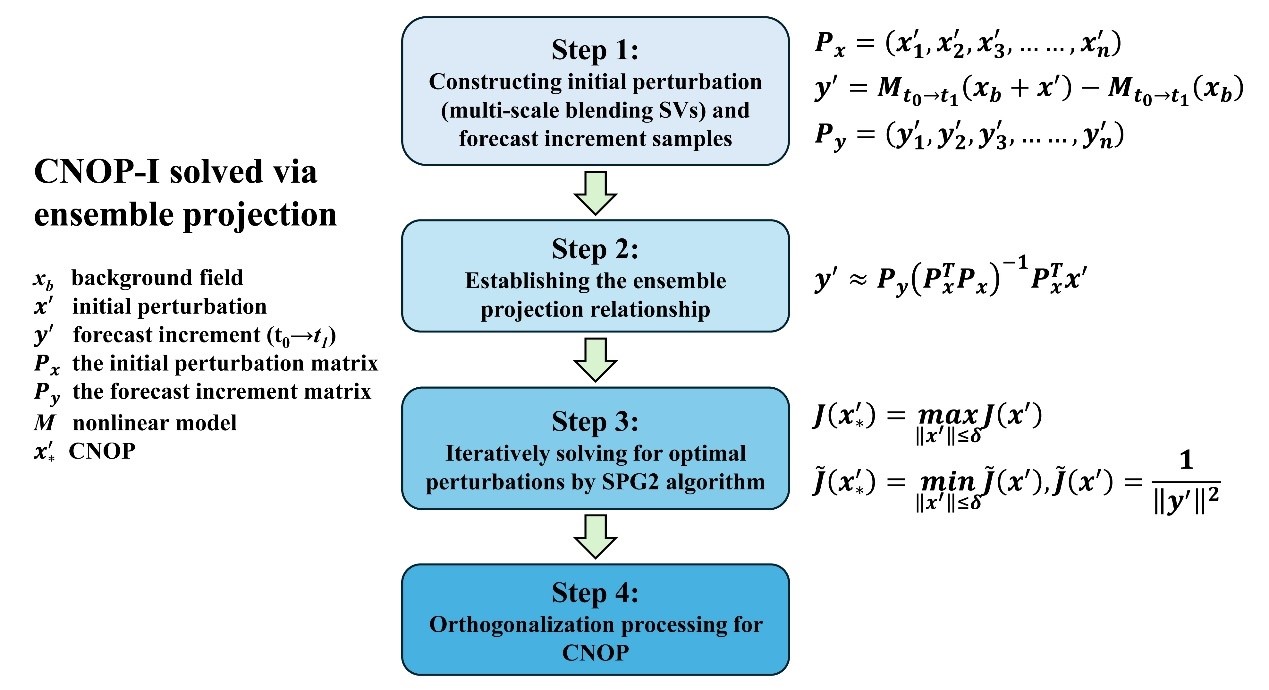
Schematic flowchart of the ensemble projection method for solving CNOP-I in the convection-allowing ensemble prediction system based on the CMA-MESO model. Credit: Hongchi Zhang.
Citation:
Hongchi Zhang, Guo Deng, Yushu Zhou, Bin Wang, Jing Wang, Juanjuan Liu, Yilin Yang, Ziyang Lai, 2025. Application of orthogonal CNOP-I in a convection-allowing ensemble prediction system based on CMA-MESO for improving extreme precipitation skill. Atmospheric and Oceanic Science Letters, 100754, https://doi.org/10.1016/j.aosl.2025.100754.
|







 Editor's choices & News