The Miocene, beginning approximately 23 million years ago, represents a canonical “warm-Earth” interval characterized by elevated atmospheric CO2 and a warmer global climate. The El Ni?o–Southern Oscillation (ENSO), as a leading mode of interannual climate variability, exerts pronounced influences on global precipitation patterns and the occurrence of climate extremes. Investigating ocean–atmosphere variability under Miocene-like high-CO2 background states therefore provides a valuable framework for evaluating climate-model performance in warm climates and for informing expectations of ENSO behavior under continued anthropogenic warming.
Recently, a collaborative team led by Associate Professor Yiwen Li of China University of Geosciences (Beijing) and Researcher Jilin Wei of the Institute of Atmospheric Physics, Chinese Academy of Sciences, together with coauthors including the study’s first author, Yujun Wang, also from China University of Geosciences, employed the fully coupled atmosphere–ocean model FGOALS-g3 and Miocene boundary conditions from the MioMIP1 framework to systematically assess the response of Miocene ENSO to increasing CO2. The study has been recently published in the journal Atmospheric and Oceanic Science Letters under the title “Nonlinear and asymmetric response of the Miocene ENSO to increasing CO2 forcing.”
A notable aspect of the analysis is a mean-state feature that is often underemphasized. Although the eastern equatorial Pacific remains relatively cool in absolute sea surface temperature, its warming response to increased CO2 is comparatively large. Given that this region is adjacent to, and partially overlaps with, key ENSO monitoring and impact domains, such spatially heterogeneous warming has the potential to modify the tropical Pacific zonal temperature gradient and associated air–sea feedbacks, thereby influencing ENSO characteristics. This consideration motivates a focused examination of changes in ENSO intensity and its spatiotemporal behavior across CO2 scenarios.
To quantify these effects, the authors conducted four Miocene CO2 sensitivity experiments under identical Miocene boundary conditions (280, 560, 840, and 1120 ppmv) and included a pre-industrial (PI) simulation as a modern benchmark. The results indicated that ENSO did not intensify monotonically with rising CO2. Instead, ENSO variability peaked under the 3×CO2 case and was substantially damped under the 4×CO2 case. Furthermore, El Ni?o events exhibited a slightly longer mean duration than La Ni?a events (approximately 12.9 months versus 12.2 months). The seasonal phase-locking of ENSO also shifted: relative to the PI benchmark, in which ENSO peaks closer to boreal winter, the Miocene experiments displayed an earlier peak, around September.
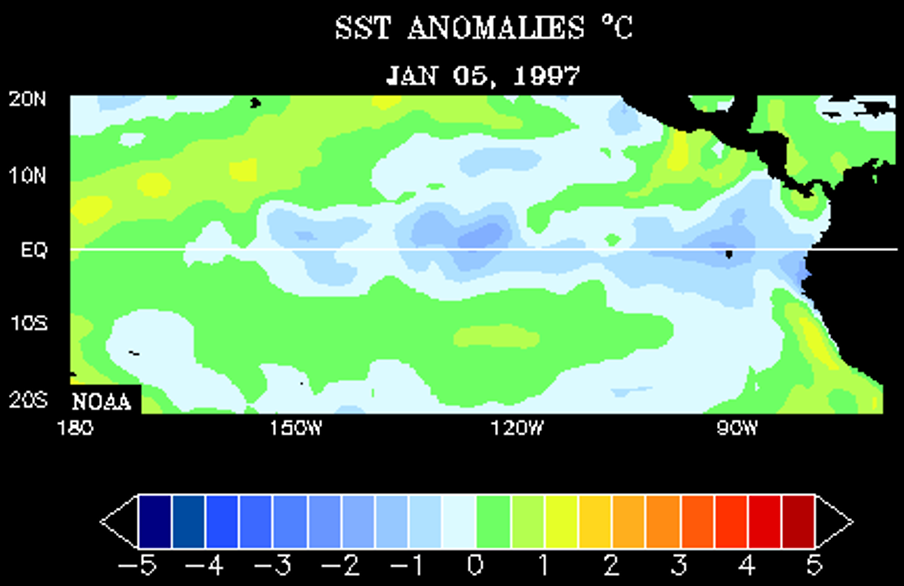
Schematic representation of ENSO evolution in the tropical Pacific (5 January 1997) (data source: https://psl.noaa.gov/map/clim/sst_olr/old_sst/sst_9798_anim.shtml )
“Our results do not support a simple linear expectation that higher CO2 necessarily yields stronger El Ni?o variability,” says the corresponding author, Yiwen Li. “Rather, the simulations suggest an inflection behavior, with amplification near a particular CO2 level followed by suppression under higher CO2.” The authors emphasize that ENSO arises from coupled ocean–atmosphere interactions shaped by multiple aspects of the background state and feedback processes, and that these results provide additional constraints for interpreting ENSO uncertainty in warm-climate conditions.
Looking forward, the team plans to extend inter-model comparisons and to incorporate constraints from terrestrial and marine proxy reconstructions. They also intend to conduct targeted sensitivity experiments involving boundary-condition components such as topography, vegetation, and terrestrial runoff, with the aim of more systematically elucidating how Miocene mean-state changes modulate ENSO intensity, spatial structure, and seasonal phase-locking.
Citation:
Yujun Wang, Yiwen Li, Jilin Wei, Chenyang Jin, Hailong Liu, Pengfei Lin, Weipeng Zheng, 2026. Nonlinear and asymmetric response of the Miocene ENSO to increasing CO2 forcing, Atmospheric and Oceanic Science Letters, 100783, https://doi.org/10.1016/j.aosl.2026.100783.
|







 Editor's choices & News