The Hadley circulation, a key atmospheric conveyor belt transporting heat and moisture from the tropics to the subtropics, directly influences subtropical aridity, the positions of tropical rainfall belts, and extreme weather risks. However, climate models have long shown inconsistencies in simulating its upper-level intensity (UP-HCI), undermining the reliability of future projections.
A research team led by the Zhangjiajie Meteorological Bureau and Nanjing University of Information Science and Technology has now provided robust projections for this critical circulation system. By applying an “attribution constraint” method based on optimal fingerprinting to correct systematic biases in CMIP6 climate models, they significantly improved the projection reliability. Their findings are published in Atmospheric and Oceanic Science Letters.
The results reveal a striking future intensification. Under the intermediate SSP2-4.5 scenario, the Northern Hemisphere’s UP-HCI is projected to increase by 26.4% by 2100, while the Southern Hemisphere sees a 62.5% increase. Under the high-emission SSP5-8.5 scenario, these numbers rise to 42.8% and 86.8%, respectively.
“Our attribution-constrained projections correct a long-standing underestimation in models,” says Prof. Bo Sun, corresponding author of the study. “The most eye-catching result is at the 2°C warming threshold. While the Northern Hemisphere shows a 43.7% strengthening, the Southern Hemisphere’s upper-level circulation intensifies by a remarkable 104.8% — more than doubling.”
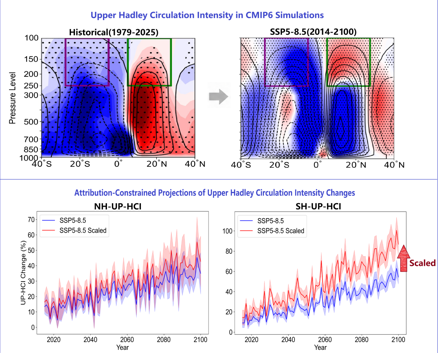
Attribution?constrained projections of upper?level Hadley circulation intensity under global warming. (Credit by Zheng Yi)
The researchers explain that this hemispheric asymmetry stems from different vertical structures: the Northern Hemisphere shows weakening in the lower troposphere but strengthening aloft, whereas the Southern Hemisphere exhibits intensification throughout the entire troposphere. Across all warming levels (from 1.5°C to 3°C), the UP-HCI intensifies progressively with global temperature, with the Southern Hemisphere showing significantly higher sensitivity.
In the future, the team plans to investigate the coupling mechanisms between the upper-level Hadley circulation and the stratosphere, as well as the implications for regional climate anomalies and tropical cyclone activity over the western North Pacific.
Citation: Yi Zheng, Bo Sun, Jie Tang, Jun Huang, Rufan Xue, Wanling Li, Siyu Zhou, Tingyun Wang, 2026. Upper Hadley circulation intensity response to future global warming scenarios. Atmospheric and Oceanic Science Letters, 100861. https://doi.org/10.1016/j.aosl.2026.100861.
|







 Editor's choices & News