Monsoon systems play a crucial role in water security and agricultural productivity across Asia, Africa, and North America, affecting the lives of billions of people worldwide. Previous studies have suggested that monsoon rainfall variability on centennial to multi-centennial timescales may be influenced by factors such as ENSO (El Ni?o–Southern Oscillation) variability, freshwater influxes, and solar activity. However, whether volcanic eruptions can drive monsoon changes on centennial timescales has remained an open question in paleoclimate research.
Recently, a research team led by Weiyi Sun from Nanjing Normal University, in collaboration with Lingfeng Wan from Ocean University of China and other colleagues, investigated the influence of volcanic activity on centennial-scale variability of Northern Hemisphere land monsoon rainfall during the Holocene. Using a transient Holocene climate simulation (iTraCE) that incorporates volcanic forcing, greenhouse gas concentrations, orbital parameters, freshwater forcing, and ice-sheet changes, the team explored the long-term role of volcanic activity in shaping monsoon evolution. The study was recently published in Atmospheric and Oceanic Science Letters.
The research team found that volcanic activity can influence not only short-term climate variability, but also monsoon dynamics on centennial timescales. Volcanic eruptions cool the Northern Hemisphere, weakening the temperature gradient between the Northern and Southern Hemispheres and thereby reducing cross-equatorial moisture transport. Meanwhile, volcanic activity can modulate a mega-ENSO-like pattern of sea surface temperature anomalies, further decreasing rainfall across the Asian, North African, and North American monsoon regions. Together, these processes shape the centennial-scale variability of Northern Hemisphere land monsoon rainfall.
The study provides the first systematic evidence that volcanic activity played a key role in shaping centennial-scale variability of Northern Hemisphere land monsoon rainfall throughout the Holocene. By extending the recognized climatic impacts of volcanic forcing from interannual and decadal scales to centennial scales, the findings offer new insights into the mechanisms of past climate variability, extreme hydroclimate events, and the future evolution of monsoon systems under changing climate conditions.
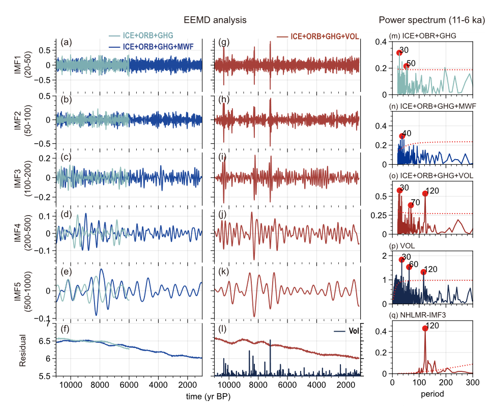
Caption: EEMD decomposition and spectral characteristics of NHLMR and volcanic forcing. Panels (c) and (i) highlight the centennial-scale components analyzed in this study.. Credit by: Weichi Ma.
Link: https://doi.org/10.1016/j.aosl.2026.100836
|







 Editor's choices & News