Ocean color remote sensing is a vital tool for monitoring global ocean carbon sinks and primary productivity. However, the on-orbit calibration accuracy of satellite sensors is insufficient, and marine weak signal only accounts for approximately 10% of the satellite received signal, which leads to significant uncertainties in the application of ocean color remote sensing. China's Fengyun-3D (FY-3D) and Fengyun-3F (FY-3F) satellites, both equipped with the Medium Resolution Spectral Imager (MERSI) sensors, have faced a persistent "weak signal, strong interference" dilemma in their ocean color observation channels, which calls for a dedicated, targeted calibration solution.
Recently, a joint research team led by the National Satellite Meteorological Center, China and the Aerospace Information Research Institute, Chinese Academy of Sciences, China has developed a vicarious calibration model for the MERSI sensors on board both FY-3D and FY-3F. This model has effectively corrected the radiometric biases in the ocean color channels of the two satellites, leading to a significant improvement in the accuracy of retrieved ocean remote-sensing reflectance. The breakthrough marks a major step forward for Chinese satellite ocean color data, enhancing quantitative application capabilities, which was recently published in Atmospheric and Oceanic Science Letters.
"Limited on-orbit sensor calibration, along with atmospheric interference, has introduced considerable biases in the observation of weak ocean signals, thereby restricting the quantitative application of ocean color remote sensing," explained Professor Chong Shi, corresponding author of the study. “Our approach leverages high-precision ground-based observations as a reference, and integrates radiative transfer simulations with regression analysis to achieve calibration of the ocean color channels. By taking into account the sensors' spectral response characteristics, this method accurately disentangles atmospheric path radiance contributions and corrects the water-leaving radiance. This study is expected to provide more reliable remote sensing data to support ocean color observation research.”
The research team plans to extend the proposed vicarious calibration framework to more complex aquatic environments, such as turbid coastal waters, and to conduct time-series analyses to monitor the long-term stability of the calibration coefficients. This study not only establishes a basis for the quantitative utilization of FY-3 ocean color data, but also provides a technical reference for the calibration of China's ocean color remote sensing data.
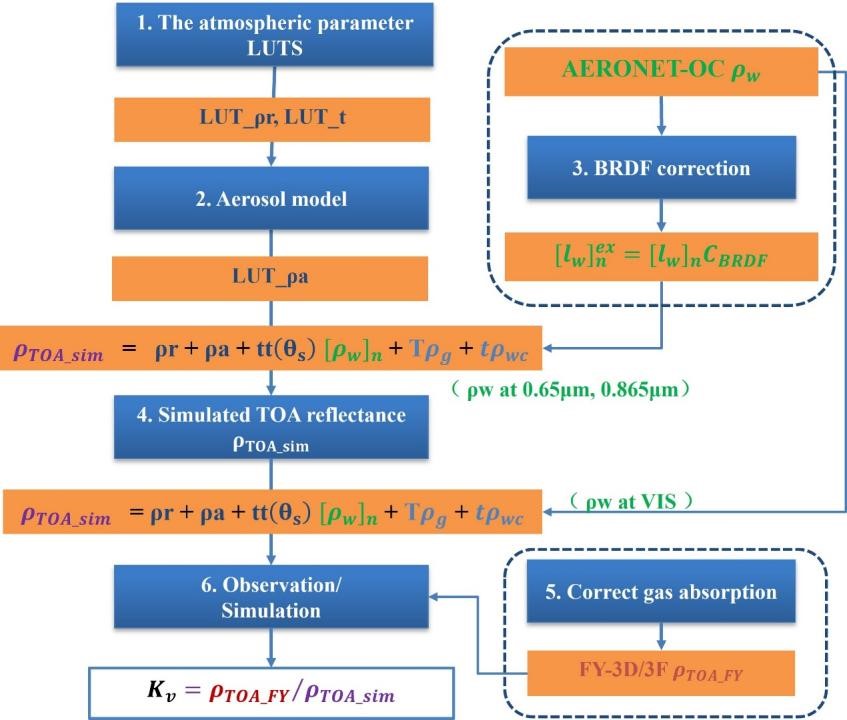
Flowchart of the radiometric vicarious calibration on FY-3/MERSI. Credit by Ni An.
Citation:
Ni An, Chong Shi, Huazhe Shang, Yuhai Bao, Lin Chen, Na Xu, Ling Sun, Ling Wang, Husi Letu, 2026. Vicarious calibration of the weak-signal ocean color channels for the Fengyun-3/MERSI sensors. Atmospheric and Oceanic Science Letters, https://doi.org/10.1016/j.aosl.2026.100869.
|







 Editor's choices & News