Thunderstorm gusts develop suddenly, affect relatively small areas, and often last only a short time. Wind speeds can rise to Force 8 or above within minutes, posing serious risks to aviation, transportation, and outdoor operations. Because conventional identification methods rely heavily on empirical thresholds and are prone to missed detections and false alarms, thunderstorm gusts remain particularly difficult to monitor and warn against.
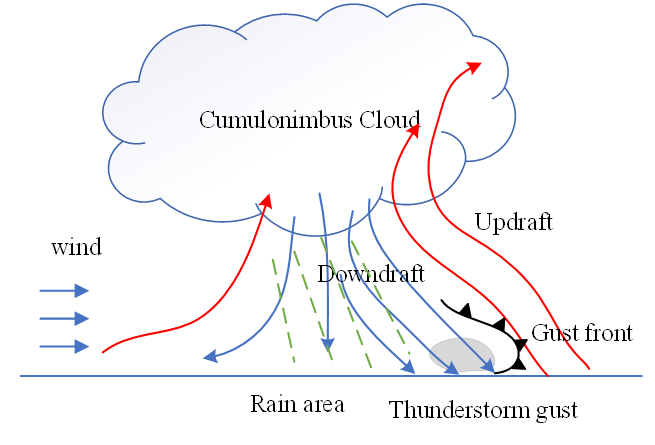
Schematic illustration of areas prone to thunderstorm gusts. Credit by Bingjian Lu.
Recently, Dr. Hengde Zhang, a senior engineer at the National Satellite Meteorological Center, China, and his jointly supervised doctoral students developed a physics-inspired multi-source spatiotemporal deep learning model known as PI-TGNet. By integrating observations from ground-based automatic weather stations, weather radar, and Fengyun-4 satellites, the model can generate regional thunderstorm-gust identification maps every 10 minutes at a spatial resolution of 1 km. These results have been published in Atmospheric and Oceanic Science Letters.
PI-TGNet learns the characteristic wind-speed changes that precede thunderstorm gusts and uses a cross-attention mechanism to connect point observations from weather stations with spatial observations from radar and satellites. “By incorporating physical guidance into the deep learning model, we enable it not only to recognize abrupt changes in wind-speed curves, but also to focus on the key structures of convective systems,” Dr. Zhang said. Tests using thunderstorm-gust datasets from eastern and southern China showed that the model achieved a probability of detection of 0.9520 and a critical success index of 0.8151.
The research team plans to evaluate the model under different regional and meteorological conditions and incorporate additional atmospheric physics into its framework. These efforts are expected to improve the model’s generalizability and provide more refined and reliable technical support for regional severe-convective-weather monitoring and early warning.
Citation:
Bingjian Lu, Zhenyu Lu, Hengde Zhang, Xiaowen Zhang, 2026. A physics–inspired multi–source spatiotemporal deep learning model for thunderstorm gust identification. Atmospheric and Oceanic Science Letters, 100893, https://doi.org/10.1016/j.aosl.2026.100893.
|







 Editor's choices & News